


My First Few Months in Bern
Updated: Dec 23, 2025
Many of you will already know that I have recently commenced my Master of Arts in Music Performance at the Hochschule der Künste Bern (HKB); a new chapter accompanied by a move of some 17,000 km from Canberra, Australia to beautiful Bern, Switzerland. I'm unbelievably grateful that my experience so far has affirmed in every way that this was the right choice. I'm so inspired by my wonderful teacher, Adam Walker, who brings such vivid, colourful musical ideas to life in every lesson. Whether it be in my flute lessons, or other courses, I learn something new every day, and I feel that I'm already growing as a musician. I'm also enjoying the opportunity to practice and improve upon my German a little each day, and have even cracked out some French on a couple of occasions (although breaking through the barrier of German words in my head has proved to be a challenge!)
Roughly three months into my adventure in Switzerland, now feels like an ideal time to share some of the inspiring experiences I've already had, and a few snippets of what I've been working on.
This is going to be a bit of a long one, so grab a cup of tea, or you can skip to:
Highlights
It's difficult to know where to start here, as there have been so many wonderful moments! For the sake of relative brevity, I'm picking a few things that spring to mind, and in doing so, I am definitely missing things. Fortunately, with two years of studies ahead of me, there's plenty of time to share more highlights down the road!
Masterclass with Gitte Marcusson
Danish-British flautist Gitte Marcusson has led an exceptional performance career, and has taught many of today's most outstanding flautists, including my current teacher, Adam Walker, and my former teacher, Joshua Batty. We were lucky enough to have Gitte with us in Bern in October for a 3-day Masterclass.
This Masterclass took on a somewhat unconventional form. As opposed to a standard Masterclass, where one student at a time plays a specific work which is then workshopped, Gitte focused significantly on communicating her overall philosophy of flute playing to us.
The first day of the Masterclass was full of extensive discussion about various aspects of flute technique, and how best to structure practice. I left with my head swimming with ideas, and excited to see them in practice. The second day focused on just that. Gitte called on volunteers to workshop various technical exercises, giving us tips about how to incorporate them into our practice. On the final day, we all participated in a mock orchestral audition, complete with a large jury (which we all sat on when not performing) and screens (orchestral auditions are often "blind", meaning that a visual barrier is placed between the candidate and the panel to minimise bias).
After a little more than a month musing over the enormous wealth of information that Gitte shared with us, here are a few points that have particularly stuck with me.
Chunking Practice
The idea of practicing in blocks is not entirely new to me. I have been structuring my practice in 45 min - 1 hour sessions for years upon advice from Eve Newsome, former oboe lecturer at the Queensland Conservatorium. The new insight I gained from Gitte was around blocking within those sessions to achieve optimal efficiency. Gitte highlighted the importance of intense concentration during practice, and suggested trying to practice in blocks as short as 3 minutes, and then pausing for a minute to reflect. I'm still working on consistently implementing this, but actively pausing during my practice to think about what I've just done and what I'm going to do next has already brought me additional focus and purpose.
Practicing Performing
Gitte stressed to us how important it is to separate the concepts of practicing and playing, where practice targets a small chunk of musical material with a specific goal in mind, usually involving a lot of repetition, whereas playing involves getting from the start to the finish without going backwards, and focusing on communicating the musical story or message. This is another idea that I was already familiar with thanks to Eve Newsome and her Optimal Performance Practice course, which I took during my Bachelor's degree. However, it was a well-timed reminder, and I particularly appreciated Gitte's encouragement to practise performing something every single day, even if it is a very small section, visualising the performance setting as vividly as possible (including turning on the camera to get used to recording, which is essential nowadays for many auditions and competitions).
The new understanding I developed was how crucial regular performance practice is in developing skills for orchestral auditions. As aspiring orchestral musicians, we spend many hours over many years fine-tuning standard excerpts from the orchestral repertoire, however I have certainly neglected regularly putting this work to the test, and seeing what holds up under pressure and what doesn't. I've definitely had experiences over the years where I've got a challenging aspect of an excerpt working in the practice room, only for it to fall apart when I turn the camera on to record, or walk into the audition room. Indeed, the mock audition we did on the 3rd day of the Masterclass was a great example of this: many things went wrong that didn't in the practice room the day before. Simulating performance on a daily basis creates opportunities for trainwrecks to occur before it's truly crunch-time, and then to tailor further practice to averting them.
Singing
Another idea Gitte really brought into focus was the importance of singing in practice. She especially recommended singing things twice: once with the flute down, a second time with the flute in playing position, and then directly afterwards playing that same phrase. I have been finding this structure to be an immensely helpful tool for a number of reasons.
As perhaps the most organically human musical act, singing is an excellent way to feel out a phrase, and build a detailed mental musical picture, which can then be transferred onto the instrument. Additionally, sometimes when I'm running up against a technical issue (particularly when it relates to managing the airstream, for instance large intervals, or producing certain tone colours) and I feel like I'm stuck, singing can be a great way to get 'unstuck'. It almost feels like a mind trick - if I can sing it, I can surely play it, right? Equally, the physicality of the placement of the voice for each note is instructive in terms of the set-up needed on the flute, and solves a lot of problems in a way that feels effortless. All in all, an excellent tool that can save a lot of time and frustration!

Photo taken after the final day of the Masterclass
Klassenaudition (Class Concert)
Each class at the HKB (ie. all the students studying with a particular professor) performs regular recitals that are open to the public. These are an opportunity to practice performing in a very supportive environment. Generally 5-10 students perform one or more movements of a piece of repertoire they are learning. In the first week of November, I had the chance to perform at my first of these concerts. It was a real privilege to have such a lovely performance opportunity so soon into my time in Bern.
For this Klassenaudition, I performed the first two movements of Martinu's First Sonata for Flute and Piano (a somewhat misleading title, given it ended up being Martinu's only sonata for flute). The first movement is sunny and joyous and full of themes that one could imagine are likely inspired by Czech folk song from Martinu's upbringing. It's a wonder that Martinu was able to produce such warm and lively music in 1945, although perhaps his relative safety in the US (to which he had fled in 1941) was a contributing factor. The second movement is heartbreakingly beautiful and more easily placeable within the wartime context. I like to imagine the very opening as ghosts looming heavy above a graveyard. The third movement, which I am yet to perform, features snappy dance-like themes, that one could tie to Martinu's time in Paris (where he lived between 1923 and 1941).
I had been hoping to learn and perform this Sonata for some time, so it was exciting to have the opportunity to realise this wish. It also brought a particular focus to the first few months of my study to get the sonata under my fingers and into my mind and heart, especially given I wanted to perform by memory. With Adam's expert guidance, I had enormous fun bringing all the musical nuances to life in my lessons. The whole Sonata features deeply conversational interplay between the Flute and the piano, which I enjoyed workshopping with our pianist, Rie Aikawa. It was then a real joy bringing it all together on stage. Over the last year, I have been reminded what a gift it is to share music with an audience, and to tell a musical story. This concert was a great chance to put that philosophy into practice, and I felt very fulfilled afterwards and excited for future performance opportunities at HKB.
You can check out a section of my performance of the 2nd movement here: https://www.instagram.com/reel/DQz4Vj_jXsP/?igsh=NTQwNW92bngzZzI=
Aside from my own performance, this concert also made me deeply grateful for the colleagues in my class. Each of their performances featured something uniquely beautiful, and I am so excited for everything that I can learn from them over the next two years.
Improv Pool
Improvisation has long fascinated me, and I've harboured a desire to develop skills in this area for quite some time. Apart from a short stint learning some jazz improvisation a few years ago, and occasional private experimentation in the practice room, I have had very little experience. As a result, I was excited to discover there is a strong focus on improvisation at HKB. All of the undergraduate performance students are actually required to take a mandatory improvisation unit - something I wish had formed part of my Bachelor's degree! Even as a Master's student there are plenty of opportunities to explore. In future semesters, I hope to take modules where I will receive explicit instruction in improvisation, but in the meantime, I have been attending the weekly "Improv Pool", which is essentially a jam session open to students from all degree programs.
The first week, I was very nervous, not being sure what to expect, and acutely aware of my minimal experience. I was not sure I was going to be able to bring myself to play anything and sure that if I did, it would be wildly out of place. In that first week, I did manage to play a few notes here and there, and although what came out of my flute wasn't always exactly what I had imagined in my head, it wasn't a disaster. I was also immediately struck by how supportive the environment was, and although it was clear to me that everyone else there was markedly more experienced, they were also extremely encouraging. I was very inspired by their artistry, and fascinated by the musical creations that came to life. Within a few weeks, I was able to shed the nerves somewhat, reassured that it was okay if I played something out of place, and that I'd be able to find a way to get back on track.
As time has gone on, the Improv Pool has become a fixture of my week that I really look forward to. Each week a slightly different group of people show up, bringing different musical experience to the table, including students studying classical, jazz and eurhythmics. This means that every week the improvisations take a different shape: sometimes more tonal, sometimes modal, sometimes with no clear tonal centre; sometimes dwelling on one musical character for the whole improvisation, sometimes rapidly shifting between many characters; sometimes focused on traditional ways of producing sound, sometimes full of extended techniques and sometimes also featuring instrumentalists switching to speaking or singing. All of this is of course also influenced by the instrumentation at hand. The first few weeks, we were lucky enough to always have exceptionally talented pianists present, who helped bind everything together harmonically and provide some structure. A few weeks later, the first time that no pianist showed up, it felt really alien to me - like something was missing. After a few weeks without a pianist, it felt like we settled into a groove, finding other ways to play with each other and tie everything together. We've now had a few weeks where only three people showed up, which presented a new challenge, and some really interesting (in the positive sense) musical results!
I've still got so much to learn about improvisation, but I can feel that it's already bringing me so much: presence in the current moment, sharpened listening and response, artistic freedom and the ability to embrace mistakes. I'm excited to see where things go over the next two years!
Thoughts from the Practice Room
The Quest for More Ease
In her Masterclass, Gitte wittily pointed out that one of the historical legends of the flute world, Marcel Moyse, has a name that, when stretched out, almost sounds like 'more ease'. It's fitting therefore that finding more ease in my playing has come into focus as a very important goal.
It's not exactly brand new information to me that sometimes my worries (particularly about getting things 'right') interfere with my playing. I do believe that my need to think things through deeply, analyse carefully and understand fully is a strength, but it can also be my worst enemy. Often thinking seamlessly turns into overthinking and I end up overcomplicating things for both my mind and my body, inadvertently creating tensions that get in the way of sound production. This is something my previous teacher, Josh, put significant effort into helping me with, and it was also brought to my attention by Michael Cox at his Flute Course in Adelaide, and by Kiri Sollis, Principal Flute of the Canberra Symphony Orchestra.
Well, I can now add at least two more names to the list of people who have brought this up with me, as Gitte noticed it immediately when I briefly played in her Masterclass, and it's been a point of focus in many of my lessons with Adam. I feel privileged to be studying with a teacher who has quickly understood my some of my idiosyncrasies and is dedicated to helping me harness them as a strength to my playing rather than a hinderance.
So the question is, being conscious of this facet of my playing, how to approach it in the practice room? If the goal is ease in playing, surely finding ease in practice, and avoiding spirals of overthinking and frustration, is an important step. Something that I have loved about many of my lessons with Adam is the way he lets musical imagination guide the way, with technique following, and I suspect the more I can bring that approach into my practice, the better. Sometimes I find to my own surprise that having a clear enough musical concept in mind is enough to produce the sound that I'm after, and that I don't need to micromanage technical aspects in the way I feel compelled to. Equally, I have been reminded of the effectiveness of good analogies. Adam is full of excellent ones, and I have also found there is something especially enriching about creating my own analogies. Something that was really helping me find resonance in my practice a few weeks ago was imagining my whole body as a string on a bowed instrument, and with each note, imagining the vibration of the string across its entire length, and feeling that vibration across my entire body. It's a process for sure, and not something that's going to turn 180º overnight, but I'm excited to find more ways to invite exploration and flow into my practice over time.
Back to Breathing
Ever since I started the flute at age 8, perhaps my most consistent point of feedback has been around the noisiness of my breath. It's been something that I have felt incredibly frustrated by in the past, as simply trying to 'open the throat' had not solved the problem for me.
I've been lucky to have had some great advice in this area over the years, and people who were very patient with me, and encouraged me to exercise that same patience towards myself. My previous teacher, Josh Batty, particularly helped me in this area. Under his guidance, for the first time I actually felt like my breathing was meaningfully improving, and that I could experience some less noisy breaths.
Of course, it's one thing to be able to take a quiet breath in the practice room with unlimited time available, and quite another to be able to do so quickly with an audience keenly watching. It's therefore perhaps not surprising that noisy breathing has emerged as an ongoing point of feedback since starting at HKB. So back to breathing we go!
It's always nice to get a slightly new angle on a challenge, and it was really helpful to dedicate almost a full lesson to breathing without the flute with Adam. He's given me some exercises to practice, and reminded me to chip away just a little each day, and not over-obsess. The work I did with Josh really helped me unlock space low in my body for the breath, and now I can focus more on unlocking other space, including sideways and into my back. An image that has been helping me is imagining a balloon inside me with the neck level roughly with my clavicle. This has been helping encourage expansion in all directions.
In terms of the noise of the breath, the big lightbulb moment for me was when Adam asked me to feel cold air hitting the back of my throat. In focusing on this, I can passively allow my body to take a natural, relaxed breath, rather than actively trying to make something happen, which usually results in some kind of interference with the breath.
I'm sure it will take some time to find a consistently quiet breath, and I might make some wrong turns along the way, but I feel more zen about that than I would have in the past, when I was full of frustration and despondency. I trust that it's a journey, and that I will get where I'm meant to in the end.
Outside Music
The People
It has been such a joy getting to know so many lovely people. The student body at HKB is very international, and I've learnt so many titbits about countries and cultures that are new to me. The environment is incredibly supportive and motivating - something I'm especially grateful for since I'm aware that is not the case at all music schools. I've already made many wonderful friends, and I'm excited to meet more over the years to come!
As a side note - the internationality of the student body at HKB is currently under threat because of a tripling of fees for new international students commencing studies in 2026 onwards. If you'd like to support the fight against this change, you can check out this petition: https://www.change.org/p/stop-the-tripling-of-tuition-fees-for-non-swiss-students-in-bern
The Change of the Seasons
When I first arrived in September, I caught a few days over 30º. Summer was definitely still in the air. This feels like a distant memory now - the cold and the dark are definitely upon us! I can't imagine a more lovely place than beautiful Bern to watch the shift of the seasons.
I have never really been someone who bought into the hype over autumn, but having now seen autumn in Switzerland, I get it. My impression is that the colours of the leaves here are much more vibrant than in Australia, although I admit this could partially be due to the excitement of being somewhere new and different.


Of course, I couldn't possibly talk about the weather without mentioning that we already had our first snowfall for the year! I've probably only seen snow 10-15 times in my life and this is my first time living somewhere where it snows, so you can imagine my excitement!
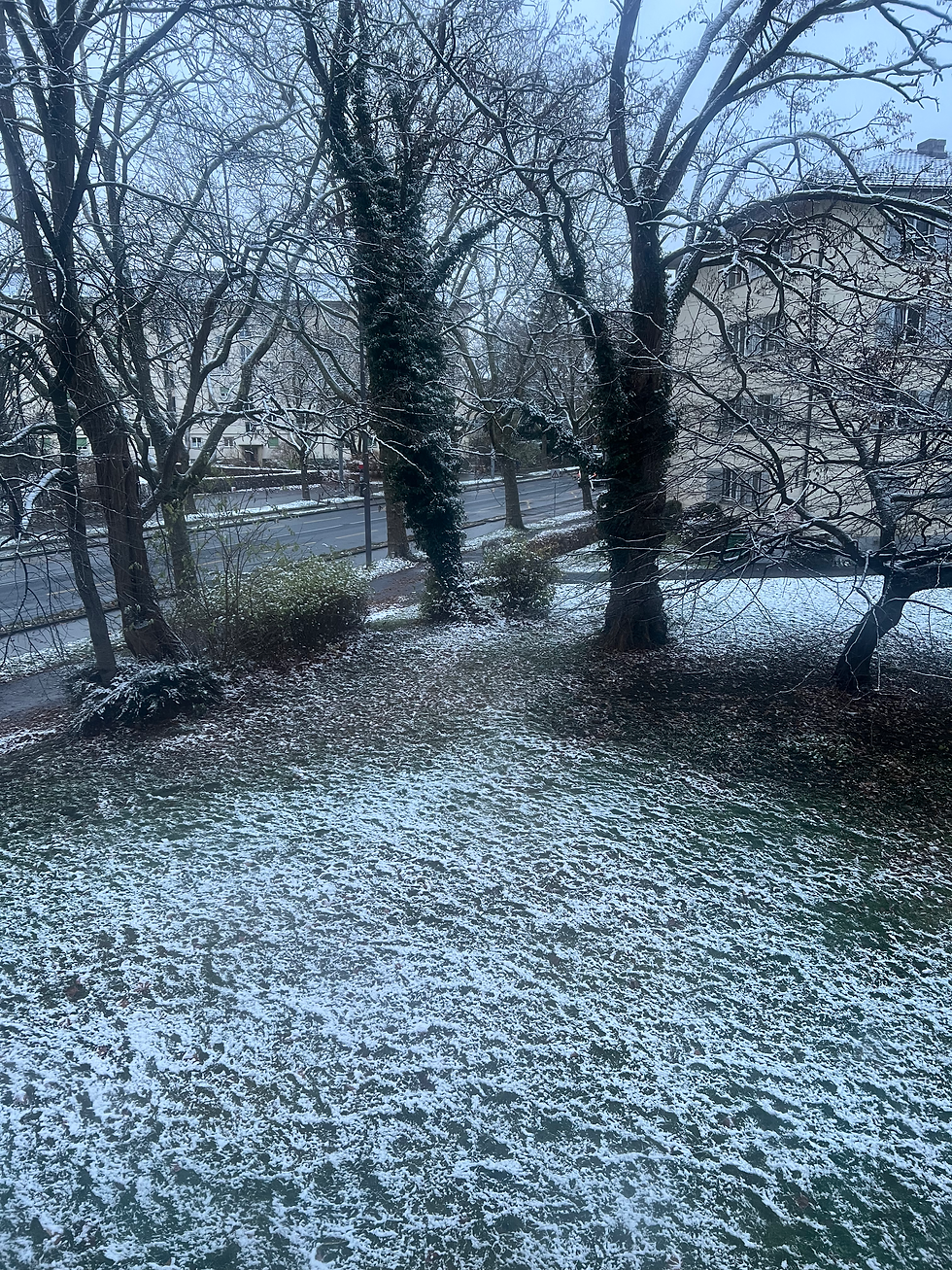
Waking up to snow outside my window!

So Christmassy!

The fields of the National Equestrian Centre near HKB under snow
Well if you're still here, we've reached the end of the line for now folks. Thanks for sticking with me through a long read! It's been a wonderful first few months, and I can't wait for what's next, and to share more soon.


Comments